
You installed the fixture. You put in a bright bulb. The porch light is technically on every evening, and yet the front of your house still feels dim, uninviting, and harder to navigate than it should be. This is a complaint homeowners raise more often than most lighting retailers acknowledge, and the answer almost never involves simply replacing the bulb with a brighter one.
Front entry darkness is a perception problem as much as a technical one, and it has specific causes that are worth understanding before spending money on additional fixtures or smarter controls.
The Fixture Placement Problem
The most common single cause of an entry that feels dark despite having exterior lights is fixture placement that creates contrast rather than coverage.
A single wall-mounted fixture beside a front door illuminates the immediate area around the door brightly while leaving everything else in relative shadow. Your eyes adjust to the brightest point in your field of vision. When that point is the fixture or the area directly around it, everything beyond that circle, the steps, the walkway, the transition from the path to the door, registers as darker than it actually is in absolute terms.
This is why adding a brighter bulb to a poorly placed fixture often makes the perception problem worse rather than better. More light in the wrong location increases the contrast between the bright zone and the surrounding darkness, making the darker areas feel more pronounced rather than less.
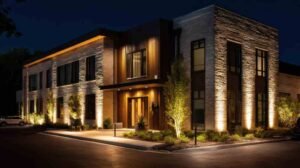
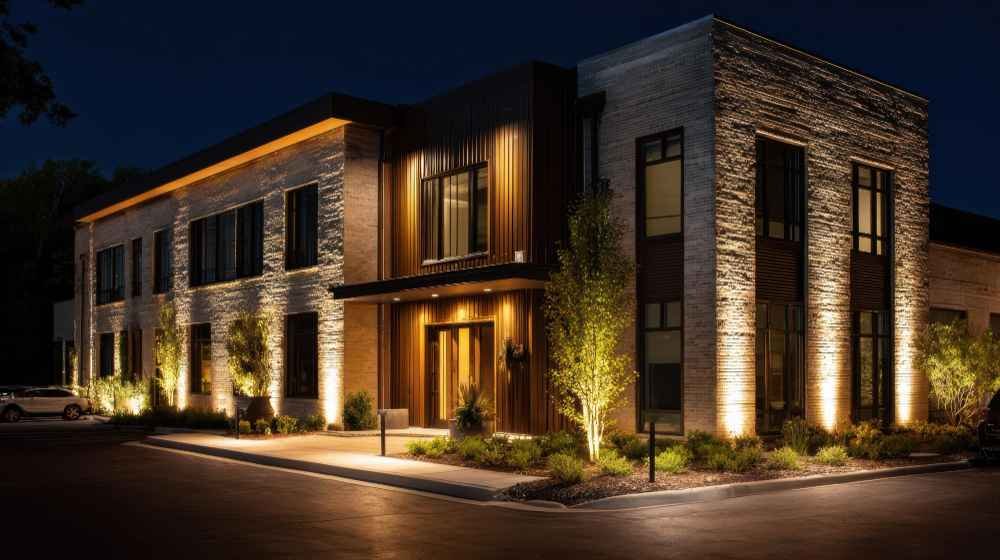
Effective entry lighting works by distributing light across the entire area a person navigates, not by creating a single bright point. Step lights, path lights, low-mounted bollards along a walkway, and secondary fixtures on garage facades or fence posts all contribute to a distributed light environment that reads as bright and safe even when no individual fixture is particularly intense.
What Deep Overhangs Do to Light
Architectural overhangs are designed to keep rain off the entry and protect the door from weather. They do this effectively, and as a side effect they block a significant portion of the light output from any fixture mounted beneath them.
A fixture mounted on the wall under a deep overhang casts light downward and outward but receives substantial interference from the ceiling above it. The overhang reflects some light back toward the house and blocks the upward component of the light output entirely. The result is a pool of light that ends abruptly at the edge of the overhang, with the steps and pathway beyond that edge receiving little benefit.
Addressing this requires either supplementary lighting beyond the overhang, recessed fixtures in the overhang ceiling itself if the structure allows for it, or pathway lighting that operates independently of the porch fixture. A single fixture under a deep overhang is rarely sufficient regardless of its wattage.
How Landscaping Creates Shadow Problems
Mature landscaping is one of the most overlooked sources of front entry darkness. Shrubs, ornamental grasses, and small trees planted near the entry path or beside the porch create shadow zones that move with the light source and block line of sight from the street to the door.
The shadow problem is particularly pronounced when landscaping has grown beyond its intended size. A shrub that was knee-height when planted and was easily illuminated from above by a fixture mounted at door height becomes a shadow-casting obstacle once it reaches chest height. The fixture that worked adequately three years ago now puts the area behind the shrub into deep shadow.
Landscaping near the entry also interferes with the ambient light contribution from street lights and neighboring properties. Dense plantings close to the walkway create a contained, shadowed corridor even when the overall neighborhood light level is reasonable.
Stair Configurations and Why They Matter
Stairs create specific visibility challenges that flat walkways do not. The vertical face of each riser is in shadow regardless of where overhead light comes from, which means that a stairway illuminated only from above or from the side has a rhythmic pattern of bright treads and dark risers that makes depth perception difficult.
This is a safety issue as much as an aesthetic one. Step lights mounted at the side of each tread or recessed into risers solve this by creating horizontal light across each step rather than relying on overhead illumination to reach the stair faces. In the absence of dedicated step lighting, the best alternative is positioning a secondary fixture at a lower height on the opposite side of the stairway from the main fixture, which fills in the shadows the main fixture cannot reach.
Long Walkways and the Attenuation Problem
Light intensity decreases with distance at a rate that is faster than most people intuitively expect. A fixture mounted at the door that adequately illuminates the porch and the first few feet of the walkway may provide very little useful light by the time the path reaches the street.
A long walkway needs light sources distributed along its length, not a single fixture at one end. This does not require an elaborate or expensive installation. Simple solar-powered path lights, low-voltage bollards, or in-ground fixtures spaced at regular intervals along a walkway transform the experience of approaching the house after dark from navigating by memory to actually being able to see where you are walking.
How Seasonal Lighting Changes the Equation
One of the more instructive experiences for homeowners who are trying to understand their entry lighting is watching what happens to the front of their house when holiday lights go up. A professionally installed seasonal display does something that a single porch fixture cannot: it distributes light across the roofline, the facade, the landscaping, and the pathway simultaneously, and the result is an entry that feels completely transformed in its visibility and warmth.
This effect is not accidental. Working with a local christmas light installation company in San Rafael means the placement of lights is considered in terms of the whole facade rather than a single point of illumination. Roofline lighting creates upward light that reflects off the underside of overhangs and softens the shadow lines that a single wall fixture creates. Lighting in the landscaping fills in the dark zones that shrubs and trees produce. Pathway lighting along the walkway solves the attenuation problem by putting light sources where the light is actually needed.
The seasonal lighting observation is useful precisely because it is temporary. Homeowners who pay attention to how much better their entry looks and feels during the weeks that seasonal lights are installed, and then notice the return to the previous condition when they come down, have a clear demonstration of what their permanent lighting is missing. The problem is not the absence of more light. It is the absence of distributed, considered light placement across the full entry experience.
Thinking About Visibility Rather Than Brightness
The reframe that most effectively guides front entry lighting decisions is shifting from asking how bright is the light to asking where can a person actually see when approaching the door after dark.
Visibility at the street. Visibility at the transition from the public sidewalk to the private walkway. Visibility along the walkway path. Visibility at grade changes and steps. Visibility at the door itself, both for the person arriving and for the occupant looking out to see who is there.
Each of those points requires its own light source at an appropriate height and angle. A single wall fixture addresses one of them. Addressing all of them requires a layered approach that most homes with a single porch light have never implemented, which is the actual explanation for why the entry feels dark even when the light is on.