

Introduction: Why Knowing Organ Locations Matters
Have you ever felt a sudden pain in your abdomen and wondered, “What organ is there?” Or maybe you’ve heard your doctor mention the “upper right quadrant” and realized you’re not sure what that means. Understanding organ locations is more than just trivia—it’s a powerful tool for self-awareness, early detection of health issues, and smarter conversations with your healthcare provider. Whether you’re a student, a parent, or simply curious about your body, knowing where your organs are can help you recognize symptoms faster and make informed decisions about your health.
In this comprehensive guide, you’ll learn about organ locations throughout the human body, from the brain and heart to the liver, kidneys, and beyond. We’ll break down the major body cavities, use easy-to-follow diagrams, and provide practical tips for mapping symptoms to specific organs. Bookmark this post for future reference—your body will thank you!
Major Organ Locations Overview
The human body is organized into three main cavities: the cranial (head), thoracic (chest), and abdominopelvic (abdomen and pelvis). Each cavity houses vital organs, and understanding these frameworks is the first step to mastering organ locations.
| Organ | Primary Location | Key Landmarks |
|---|---|---|
| Brain | Cranial cavity | Protected by skull |
| Heart | Mediastinum, chest center | Between lungs, 5th rib level |
| Lungs | Thoracic cavity, either side | Apex above clavicle |
| Liver | Upper right abdomen | Under diaphragm, ribs 5-10 |
| Kidneys | Retroperitoneal, lower back | T12-L3 vertebrae level |
Surface anatomy landmarks—like the ribs, sternum, and umbilicus—help pinpoint organ locations without imaging. For example, the heart sits just left of the breastbone, while the liver is tucked under the right rib cage. These reference points are crucial for both medical professionals and anyone wanting to understand their own body better.
Head and Thoracic Organ Locations
Brain: The Command Center
The brain sits within the cranial cavity, protected by the skull. It’s divided into lobes—frontal (front), parietal (top), temporal (sides), and occipital (back)—each with specialized functions. The brainstem, including the medulla, connects the brain to the spinal cord and controls vital processes like breathing and heart rate.
Heart: Central Pump of the Chest
The heart is located in the mediastinum, slightly left of the midline, between the second and fifth intercostal spaces. It’s nestled between the lungs and sits just above the diaphragm. The heart’s four chambers (two atria, two ventricles) work together to circulate blood throughout the body.
Lungs: Oxygen Factories
The lungs occupy most of the thoracic cavity, flanking the heart. The right lung has three lobes, while the left has two (to make room for the heart). Each lung extends from just above the clavicle (collarbone) down to the diaphragm. The pleura, a double-layered membrane, covers and protects the lungs.
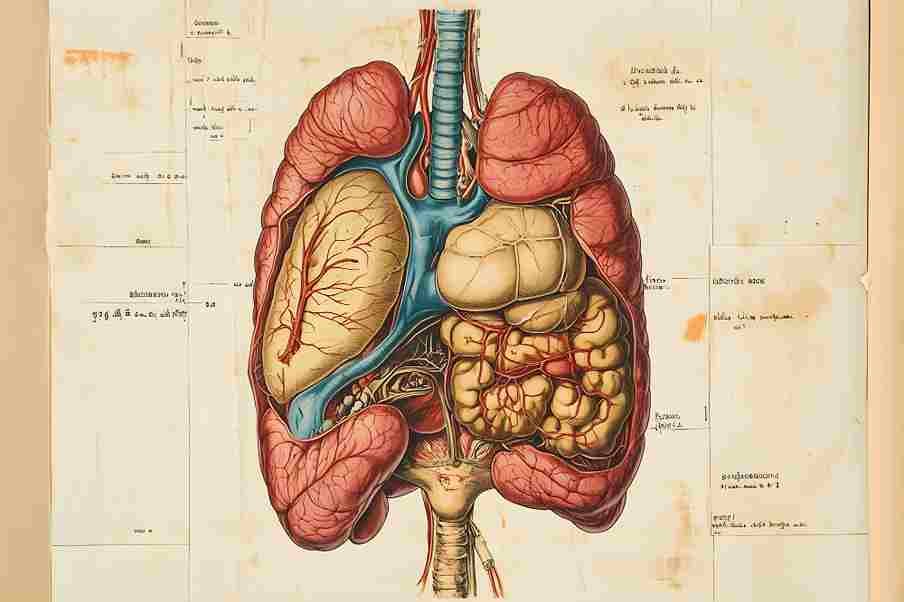
Diagram description: Visualize lung organ locations spanning from the base of the neck to the diaphragm, with the heart nestled slightly left of center.
Health note: Pain or discomfort in the chest may signal issues with the heart or lungs—never ignore persistent symptoms.
Abdominal and Pelvic Organ Locations
The abdomen is divided into four quadrants for precise mapping of organ locations:
- RUQ (Right Upper Quadrant): Liver, gallbladder, part of the colon
- LUQ (Left Upper Quadrant): Stomach, spleen, pancreas tail
- RLQ (Right Lower Quadrant): Appendix, right ovary, cecum
- LLQ (Left Lower Quadrant): Sigmoid colon, left ovary
| Quadrant | Key Organs |
|---|---|
| RUQ | Liver, gallbladder |
| RLQ | Appendix, right ovary/duct |
| LUQ | Stomach, spleen, pancreas tail |
| LLQ | Sigmoid colon, left ovary |
Liver and Gallbladder
The liver dominates the RUQ, just beneath the right diaphragm and ribs 5-10. The gallbladder nestles under the liver’s right lobe. Both are crucial for digestion and detoxification.
Stomach
The stomach sits in the LUQ, with its cardia just below the esophagus and its pylorus leading to the duodenum. It’s tucked under the left rib cage, making it easy to locate with gentle pressure.
Pancreas and Spleen
The pancreas lies retroperitoneally (behind the abdominal lining), stretching from the right (head) near the duodenum to the left (tail) near the spleen. The spleen, a lymphatic organ, sits high in the LUQ, protected by the 9th-11th ribs.
Intestines
The small intestine coils centrally, while the large intestine frames the abdomen. The appendix, a small pouch, is found at McBurney’s point in the RLQ—about one-third of the way from the right hip bone to the navel.
Kidneys
The kidneys are retroperitoneal, located in the lower back on either side of the spine (T12-L3 vertebrae). They’re protected by the lower ribs and flank muscles.
Pelvic Organs
The bladder sits just behind the pubic bone, below the peritoneum. In females, the uterus and ovaries are centrally located in the pelvis, while in males, the prostate is just below the bladder.
Organ Functions Tied to Locations
The position of each organ is no accident—location supports function and protection. Here’s how:
- Liver: Its upper right spot allows direct blood flow from the digestive tract for detoxification and metabolism.
- Heart: Central chest placement ensures efficient circulation to all body parts.
- Lungs: Protected by the rib cage, their lateral position maximizes oxygen exchange.
- Kidneys: Flank location near the aorta and vena cava enables rapid blood filtration.
- Brain: Encased in the skull for maximum protection, with proximity to sensory organs.
Health tip: Knowing organ locations helps you map symptoms (e.g., RUQ pain = liver/gallbladder, flank pain = kidneys) and seek timely care.
Visual Aids: Organ Locations Diagrams
A picture is worth a thousand words. Use full-body diagrams (anterior and posterior views) to see human organ locations at a glance. Cross-sectional images reveal how organs are layered and connected. Look for interactive tools or downloadable PDFs labeled “human organ locations diagram” for hands-on learning.
Common Health Issues by Organ Locations
- Chest pain: May indicate heart or lung problems—seek immediate care if severe or persistent.
- RUQ discomfort: Often linked to liver or gallbladder issues (e.g., hepatitis, gallstones).
- Flank pain: Common with kidney stones or infections.
- Lower abdominal pain: Could signal appendicitis, ovarian cysts, or bladder infections.
Understanding organ locations empowers you to describe symptoms accurately and get the right help. Always consult a healthcare professional for diagnosis and treatment.
FAQ: Organ Locations Explained
What are the five vital organ locations?
The brain (cranial cavity), heart (center chest), lungs (either side of chest), liver (upper right abdomen), and kidneys (lower back/flanks) are the five vital organs and their primary locations.
How can I identify abdominal organ locations?
Divide the abdomen into four quadrants using the navel as a center point. Each quadrant contains specific organs—see our quadrant table above for details.
Is there a diagram of organ locations I can download?
Yes! Many medical sites and anatomy resources offer free PDFs of organ locations diagrams. Look for interactive tools or printable charts for study and reference.
Why do organ locations matter for health?
Knowing where organs are helps you recognize symptoms, communicate with doctors, and understand your body’s signals—crucial for early detection and prevention.
Key Takeaways: Mastering Organ Locations for Better Health
- Understanding organ locations helps you map symptoms and seek care faster.
- Body cavities and surface landmarks are key to pinpointing organs.
- Diagrams and quadrant maps make learning organ locations easy and visual.
- Bookmark this guide and share your organ locations quiz score with friends!
Conclusion: Your Guide to Organ Locations in 2026
Knowing your organ locations is a lifelong skill that empowers you to take charge of your health. From the brain to the bladder, every organ’s position has a purpose. Use this guide, explore diagrams, and stay curious about your anatomy. For more on human anatomy basics or organ health tips, sign up for our newsletter and never miss an update!