
Every business wants its employees to get as much work done as they can, but a poorly designed workplace kills productivity. Most managers don’t know that the interior design of their office is a powerful influence on their employees’ behaviour. But studies from the World Green Building Council and other organisations have repeatedly shown that it significantly affects the health, well-being and productivity of their staff.
By taking the initiative and refreshing your workplace with productivity in mind, you could gain a real edge over your competition. To help you, we’ve looked at the changes that professional office designers love to make and narrowed down the most powerful. Here are the best workplace renovations you can make, so that your employees will finally love coming into the office again.
Reorganise Your Layout to Enhance Flow
The physical flow of your office space impacts the speed of your workflow. Imagine, for example, that an employee needs to get documents physically signed by a manager whose office lies at the other end of the space. They’ll likely wait until they’ve got lots of documents before making the trip, creating a bottleneck. If a line of people waiting for the printer is blocking their path, perhaps they’ll wait even longer.
Office layout improvements are the low-hanging fruit of workplace redesigns. You only need to move around what you already have to ensure it fits your current workflows, not undertake a full renovation. Try to find ways to keep pathways free and place essential tools in areas that are intuitive to find and convenient to access. Another smart way to use space is to position quiet zones far away from collaborative zones or coffee stations.
Embrace Ergonomics
Some managers think ergonomics is simply about comfort, and therefore ergonomic furniture is nice for your employees to have if you have the budget, but not essential. This is a mistake. Ergonomics has a direct impact on the energy levels and long-term health of your employees, and it helps minimise distractions. Enabling proper blood circulation prevents them from becoming sluggish, and preventing pain and discomfort removes a major source of distraction.
Lumbar-supporting chairs are the most well-known pieces of ergonomic furniture, but don’t stop there. Make sure that desks are the right height so that your employees’ wrists and elbows are properly aligned, and consider using adjustable desks so that they can stand if they find themselves getting too stiff. Adjustable monitors help reduce neck pain, too. Don’t limit ergonomics to your employees’ primary desks, either. It’s also important in meeting rooms and lounges.
Refresh the Colour Palette
If you’re considering actual office renovations, then one of the best ways to begin is by switching up the colour scheme of your space. Colours actually exert a subtle influence on behaviour. We seem to recognise this when decorating our homes, where we focus on colours that help create a calm environment, yet it’s often forgotten when designing office spaces. Used effectively, it’s one of the most impactful workspace upgrades you can make.
Currently, research seems to point towards a natural colour palette as the best for productivity. This means focusing on neutral, earthy tones like deep blues, olive, peach and terracotta. They’re stimulating without being stress-inducing or distracting. Brighter colours can be used for creative spaces where you want people to be energetic and alert, but the overall colour scheme of your office should be coherent. This creates an impression of orderliness and professionalism.
Upgrade Your Lighting
Something else that we recognise the power of outside of work is lighting. We’ve all heard of “mood lighting” and may have experienced it at home or in restaurants or hotels, but lighting barely gets a second thought in most offices. Of course, your workspace is not somewhere you want mood lighting, but you shouldn’t just go as bright as possible either. Good lighting boosts energy and reduces eyestrain.
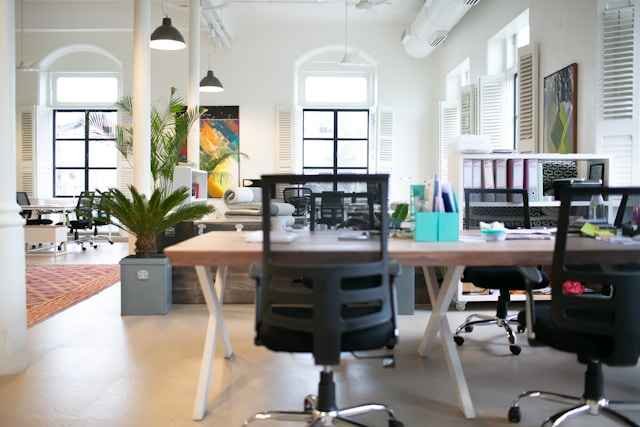
A good approach is to effectively combine natural light, overhead lighting such as flat-panel LEDs, and adjustable desk lamps. Natural light should be used as much as possible, as it is strongly associated with boosting energy and well-being. Overhead lights help in areas where natural light can’t reach or at darker times of the year, and desk lamps allow employees to tweak the level of light to their own level of comfort.
Introduce Natural Elements
Another easy work setting enhancement to make is bringing in some natural materials and plants. The logic behind introducing these is much the same as for choosing natural, earthy colours. There’s something about being surrounded by them that makes people feel energised, comfortable and happy all at once, like taking a leisurely hike in a forest. The effect is especially strong when these elements are combined with ample natural light.
Plants, in particular, are very good to have in the office. Besides being pleasant to look at, they can help improve the air quality inside. The oxygen-rich air they create is ideal for improving the mood, energy and cognitive performance of employees. However, don’t overlook natural materials and textures like wood, cork and stone. These make a nice change from cold plastics and are a lot more pleasant to touch.
Add or Improve Break Areas
It is becoming widely understood that wellness isn’t a passing fad and that stress is a silent killer, which is why many of the world’s most successful companies are now taking breaks seriously. That doesn’t just mean allowing more of them and acknowledging that they are not merely wasted time, but it also means creating relaxing, sanctuary-like environments for workers to escape to during the workday.
You can do this by creating spaces away from working areas with soft seating, warm lights, and calming audiovisual elements like fountains. Fresh air, water and snacks are also ideal if you can provide them.
Conclusion
As our knowledge of how environments shape moods and behaviours has increased, companies providing just the bare minimum for employees have started falling behind. To get ahead, you should see work environment modification as a tool to help get the best out of your employees over the long run, not an expensive inconvenience. Use these tips to start enjoying a happier, more productive office now.